
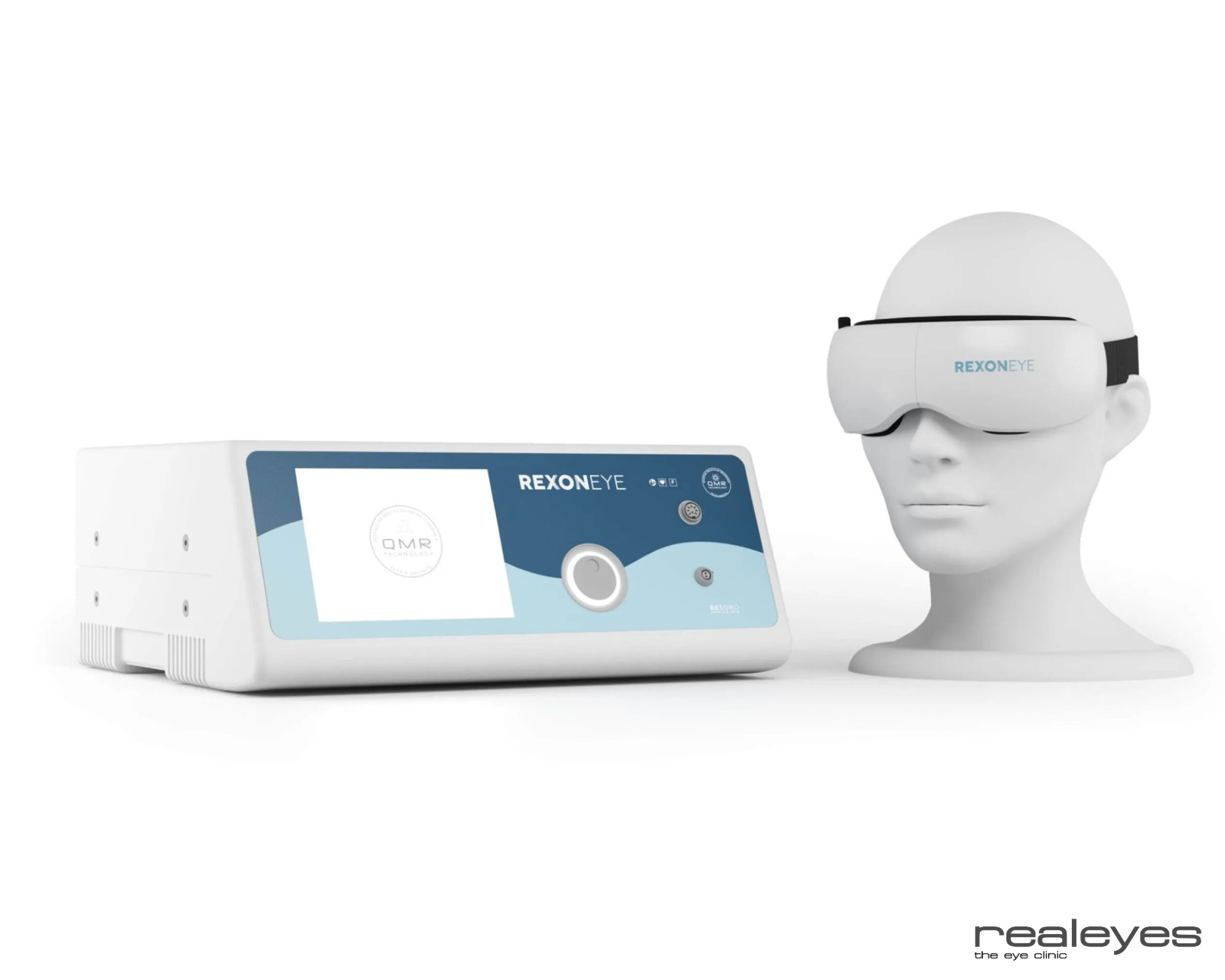
If you’ve been using eye drops for months and still wake up with gritty, sore eyes, you may have come across Rexon-Eye treatment. It’s a newer in-clinic therapy for dry eye. Rather than adding moisture from the outside like drops do, it aims to help your eyes produce a healthier tear film themselves.
Most of what you’ll find about it online is either a clinic advert or a technical abstract written for professionals. This guide explains how Rexon-Eye works, what happens during a session, how many treatments you’re likely to need, and who it tends to suit.
We see people at our dry eye clinic every week who had put their irritated, watery eyes down to age or long days at a screen. Often it was dry eye all along, and for some of them Rexon-Eye has become part of their treatment plan.
What Rexon-Eye Treatment Is and How It Works
Rexon-Eye treatment is a non-invasive therapy for chronic dry eye, delivered in a clinic. A trained clinician places a mask over your closed eyes, and the device applies low-power, high-frequency electrical fields to the eyelids and surrounding tissue.
Its purpose is to support the tear film and the health of the ocular surface (the cornea, conjunctiva and lid margins that your tears protect). To see why that matters, it helps to understand how tears work.
Healthy tears have three layers: a mucin layer that helps tears stick to the eye, a watery aqueous layer, and an oily lipid layer that slows evaporation. When glands or ducts stop working well, that balance tips. Many people with dry eye actually produce plenty of tears, which is why eyes that water all the time often point towards dry eye rather than away from it.
New to dry eye? Our guide explains what dry eye syndrome is and why it develops.

The Technology Behind the Treatment
Rexon-Eye is a medical device made by Resono Ophthalmic Srl and distributed in the UK through Hanson Medical. Resono Ophthalmic describes its technology as Quantum Molecular Resonance, a form of electrical stimulation it says encourages cell metabolism in the eyelid and ocular surface tissues.
The approach is regenerative, meaning it aims to help the tissues that produce and hold tears function better rather than simply topping up moisture. That mechanism rests largely on manufacturer information. Independent research has not yet confirmed exactly how, or how consistently, it works.
What a Typical Session Involves
Your first appointment usually starts with a dry eye assessment to confirm the type and severity of your condition. An eye care professional then fits the mask, you lie back with your eyes closed, and the device runs for around 20 minutes. Most patients find it comfortable and return to normal activities straight afterwards.
At Realeyes, a course of Rexon-Eye treatment consists of four 20-minute sessions, one week apart. Other practices use different protocols, so follow the plan and aftercare your own clinician gives you, which often includes continuing lid care and drops between visits.

Why It Is Professional Use Only
Can Rexon-Eye be used at home? No. The device is CE marked as a medical device and listed for professional use only, including in the Eye Drops Database. A qualified, appropriately trained clinician has to assess your eyes and administer it. No consumer version exists, so treat any home-use offer with suspicion.
Who Rexon-Eye Can Help, and When It May Not Be Right
Not everyone with dry eyes needs an in-practice therapy. For many people, lid care and the right drops are enough. Rexon-Eye usually enters the conversation when those steps stop making a meaningful difference.
Why Would I Have Rexon-Eye Treatment?
Rexon-Eye is usually considered when chronic dry eye keeps coming back despite consistent home care. The manufacturer and clinics that offer it say it’s suited to people experiencing:
Persistent burning, gritty or tired eyes
Blurred vision that clears on blinking, particularly when reading
Contact lens discomfort
Ocular surface stress after eye surgery
Dry eye linked to autoimmune conditions such as Sjögren’s syndrome
Hormonal or age-related changes
In our clinic, we mainly use it for chronic, stubborn or mixed cases. Before recommending any treatment, your clinician will grade your symptoms with a questionnaire and examine the surface of your eye, checking tear break-up time, surface staining, the appearance of your meibomian glands and your tear volume.
If contact lenses are part of the picture, our piece on common contact lens myths is a useful read.
Cautions, Contraindications and Possible Side Effects
Rexon-Eye isn’t suitable for everyone, so your clinician will check for anything that rules it out before your first session. Screening for electrical treatments usually covers implanted electronic devices such as pacemakers, pregnancy, active eye infection or inflammation, and any known hypersensitivity. Ask your clinician to go through the full list of contraindications with you.
Serious side effects haven’t been widely reported, but published data is still limited. If you feel any irritation or discomfort during a session, tell your clinician straight away. If you notice discomfort or changes in your vision afterwards, contact the practice before your next session. For sudden or severe changes in vision, seek urgent care.
How to Improve Evaporative Dry Eye
Evaporative dry eye is the most common form, and it is most often linked to meibomian gland dysfunction (MGD). The meibomian glands line your eyelid margins and produce the oil that forms the tear film's outer layer. When they block or produce poor-quality oil, tears evaporate too quickly.
Management usually layers several approaches. Rexon-Eye is one option among many, not the answer on its own.
Everyday Habits and Lid Care
A warm compress held over closed eyes for 5 to 10 minutes softens thickened oil in the glands. Follow it with gentle lid hygiene to clear debris from the lash line. If you also have blepharitis, our article on how to clear up blepharitis quickly explains daily lid cleaning in detail.
Screen work reduces full blinking, so take regular breaks and close your eyes completely now and then. Our guide on whether using a computer can damage your eyes covers screen habits. A humidifier, enough water through the day, and keeping fans, car vents and smoke away from your face all help too.
Choosing Between Options With Your Clinician
A full dry eye assessment comes first. Then ask:
Which subtype do I have: evaporative, aqueous-deficient or mixed?
What evidence supports this option for my subtype?
How many sessions should I expect?
What happens if it doesn't help?
What is the total cost, including follow-ups?
Key Takeaways on Rexon-Eye Treatment
Rexon-Eye is a CE-marked device for professional use. It applies low-power electrical fields through a mask placed over closed eyes, with the aim of supporting tear production and the health of the eye’s surface in people with chronic, stubborn or mixed dry eye.
At Realeyes, Rexon-Eye is available through our Dry Eye Clinic at our New Addington, Whitton, Harrow Road and Streatham branches. Every treatment starts with a full dry eye assessment. That way we can confirm your type of dry eye and talk you through every option, so you know whether Rexon-Eye is the right fit before you begin.
If dry eye is affecting your daily life, book a dry eye assessment online, call your local branch or pop in to see us. You can find your nearest practice on our branches page.

